
What is the Best AI-Driven Content Optimization Strategy for SaaS
The definitive engineering guide to scaling organic traffic by 300%+ across traditional Google SERPs and generative AI engines.

AI-Driven Content Optimization Strategy: The 2026 Framework for Enterprise Growth Teams
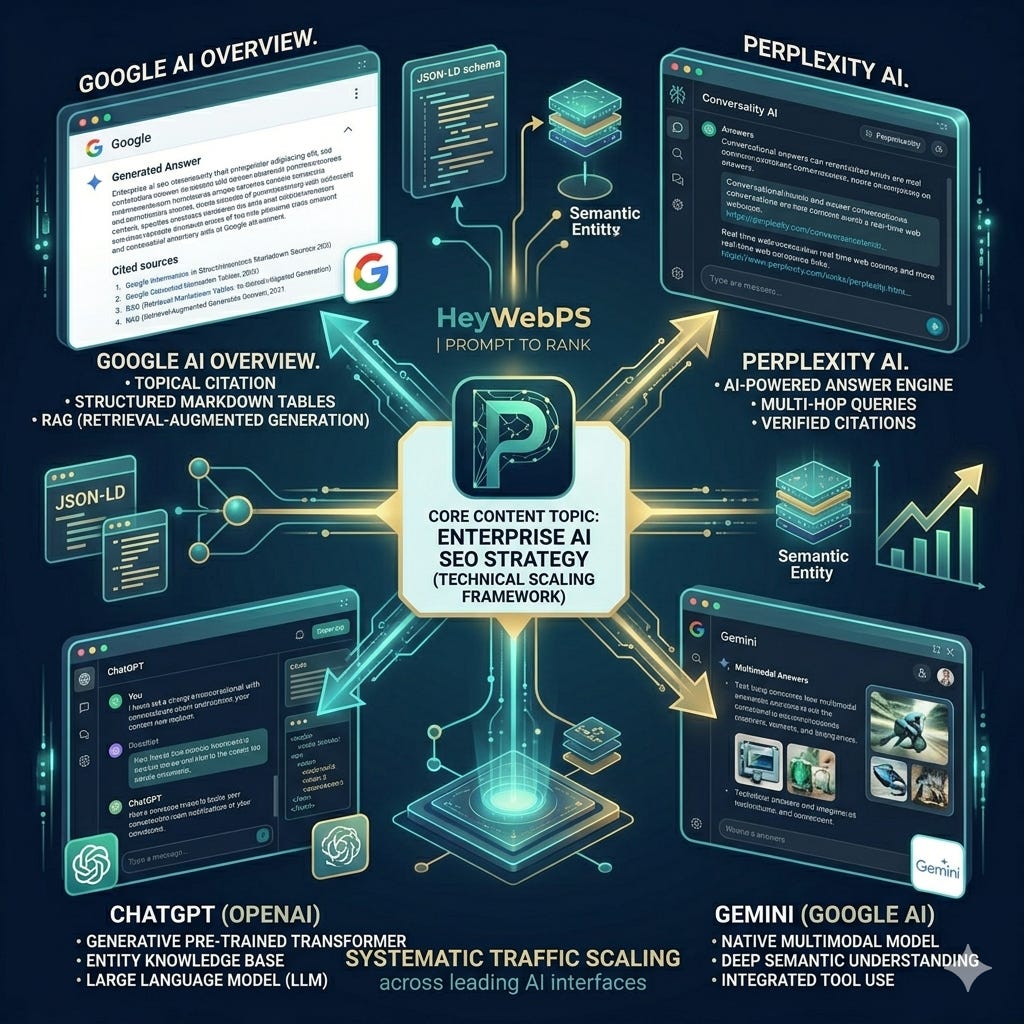
If your AI-driven content optimization strategy still treats “ranking” as a single goal — getting a blue link on page one of Google — you’re already behind. In 2026, the same piece of content has to perform across at least seven surfaces: Google Search, Google AI Overview, ChatGPT, Perplexity, Gemini, Bing Copilot, and increasingly Claude-powered research tools. Each of these reads, summarizes, and cites content differently, and most enterprise content teams are still publishing for one audience while five others quietly ignore them.
Executive Summary
What you’ll learn:
Why traditional SEO frameworks fail across AI Overviews, ChatGPT, and Perplexity
A repeatable, step-by-step AI content optimization framework
How to structure content for both human readability and AI extraction
A real-world before/after case study with metrics
A 30-day execution roadmap your team can start this week
Quick answer: An effective AI-driven content optimization strategy combines traditional technical SEO with entity-rich, extractable content structures (clear definitions, summaries, tables, and Q&A formats) that both search engines and large language models can parse, trust, and cite as a source.
The Problem: Why Most Content Strategies Are Already Outdated
For nearly two decades, content optimization meant one thing: satisfy Google’s algorithm well enough to rank in the top ten organic results. Teams built editorial calendars, keyword maps, and link-building campaigns around that single target.
That target has fractured. Search behaviour has shifted from “type keywords, click links” to “ask a question, get a synthesized answer.” Enterprise buyers now research vendors, frameworks, and strategies through conversational AI tools before ever visiting a website. When a CMO asks ChatGPT “what’s the best AI-driven content optimization strategy for enterprise teams,” the model doesn’t return ten blue links — it returns a synthesized answer, often citing two or three sources it considers authoritative, clear, and well-structured.
This creates a new kind of risk and a new kind of opportunity. The risk: content that ranks well on Google but is poorly structured for extraction may never get cited by AI Overviews, Perplexity, or Gemini — effectively becoming invisible to a growing share of research traffic. The opportunity: content engineered for both traditional ranking signals and AI extractability can dominate across every surface simultaneously, compounding visibility in a way that wasn’t possible before.
The pain point isn’t a lack of content. Enterprise marketing teams already produce enormous volumes of content. The pain point is that most of it is structured for skimming humans and crawling bots from 2018 — not for the entity-recognition, summarization, and citation logic that AI systems use in 2026.
The Framework: A Step-by-Step AI Content Optimization Process
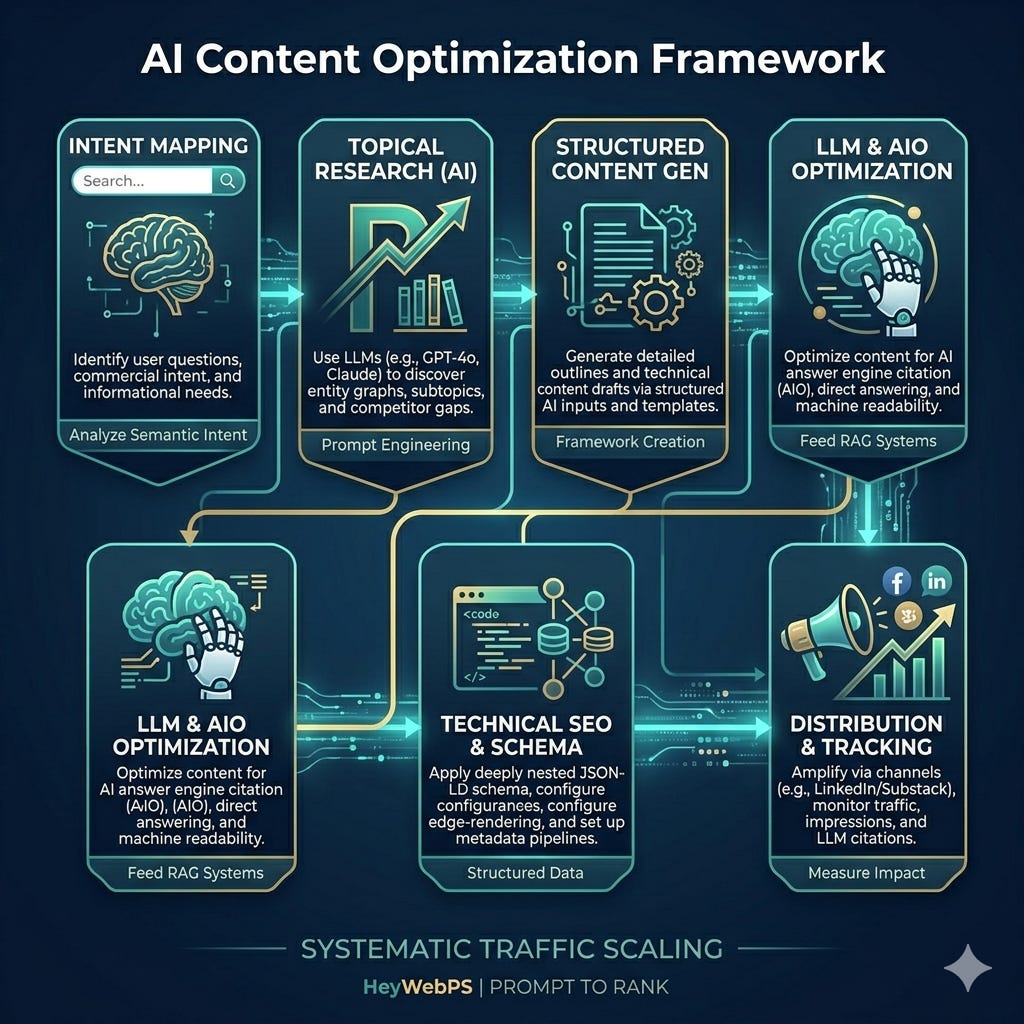
H2: Step 1 — Map Search Intent Before Writing Anything
Before drafting a single sentence, classify the query your content targets across four dimensions:
H3: Primary, Secondary, Hidden, and Emotional Intent
Primary intent: The explicit ask (e.g., “how do I build an AI-driven content optimization strategy”)
Secondary intent: The adjacent need (e.g., “what tools do I need”)
Hidden intent: The unstated concern (e.g., “will this make my current content team’s work obsolete, or augment it”)
Emotional intent: The underlying feeling (e.g., pressure to show measurable AI ROI to leadership this quarter)
Enterprise content frequently ignores hidden and emotional intent, which is exactly where competitors differentiate. A CMO Googling AI SEO strategy isn’t just curious — they’re often under pressure to justify budget, headcount, or a pivot away from legacy agencies.
H2: Step 2 — Build an Entity-First Content Outline
H3: Why Entities Matter More Than Keywords
AI systems and modern search engines increasingly think in entities — people, brands, technologies, concepts — and the relationships between them, rather than isolated keyword strings. Before outlining sections, list every entity your content should clearly define and connect: the platforms (Google AI Overview, ChatGPT, Perplexity, Gemini), the concepts (GEO, AEO, AIO, E-E-A-T), and the tools your audience uses daily.
H4: Practical Entity Mapping Steps
List every platform, concept, and tool relevant to the topic
Write a one-sentence, unambiguous definition for each
Explicitly connect entities (”AEO is a subset of GEO focused on direct-answer formats”)
Use consistent terminology throughout — don’t alternate between synonyms for the same concept
H2: Step 3 — Structure for Dual Extraction (Human + AI)
H3: The “Answer-First” Paragraph Pattern
Lead each major section with a 1–3 sentence direct answer, then expand with context, nuance, and examples. This pattern serves skimming humans, featured snippet algorithms, and AI summarization models simultaneously.
H3: Use Tables, Lists, and Defined Terms Liberally
Tables and labelled lists are dramatically easier for AI systems to parse and cite accurately than dense prose. Wherever you’re comparing options, showing before/after data, or listing steps — use a table or numbered list instead of a paragraph.
H2: Step 4 — Build an “AI Optimization Layer” Into Every Article
This is the step most content strategies skip entirely. After writing your human-facing article, add a dedicated section containing concise, self-contained summaries written specifically for AI consumption — short blocks that answer the core question completely in under 100 words each, formatted so an AI Overview, ChatGPT, or Perplexity can lift them directly as a citation-worthy answer.
H2: Step 5 — Earn E-E-A-T Signals Through Specificity, Not Volume
H3: Replace Generic Claims With Specific, Checkable Detail
“AI SEO can boost your traffic significantly” demonstrates nothing. “A documented 30-day rollout with before/after impression and CTR data” demonstrates experience. AI systems and Google both increasingly favour content that reads as written by someone who has actually done the work — specific timeframes, specific metrics, specific trade-offs.
H2: Step 6 — Distribute and Re-Promote Across AI-Indexed Channels
Publishing is no longer the finish line. Content that gets referenced, linked, and discussed across multiple platforms (newsletters, social posts, community notes) sends additional authority and freshness signals that influence both traditional rankings and AI citation likelihood.
Case Study: Applying the Framework — Illustrative Before/After Metrics
The table below illustrates the type of impact enterprise teams commonly report after restructuring a cluster of cornerstone articles using the framework above over a 90-day period. Use it as a benchmark template for setting your own goals — actual results vary by industry, domain authority, and content volume.
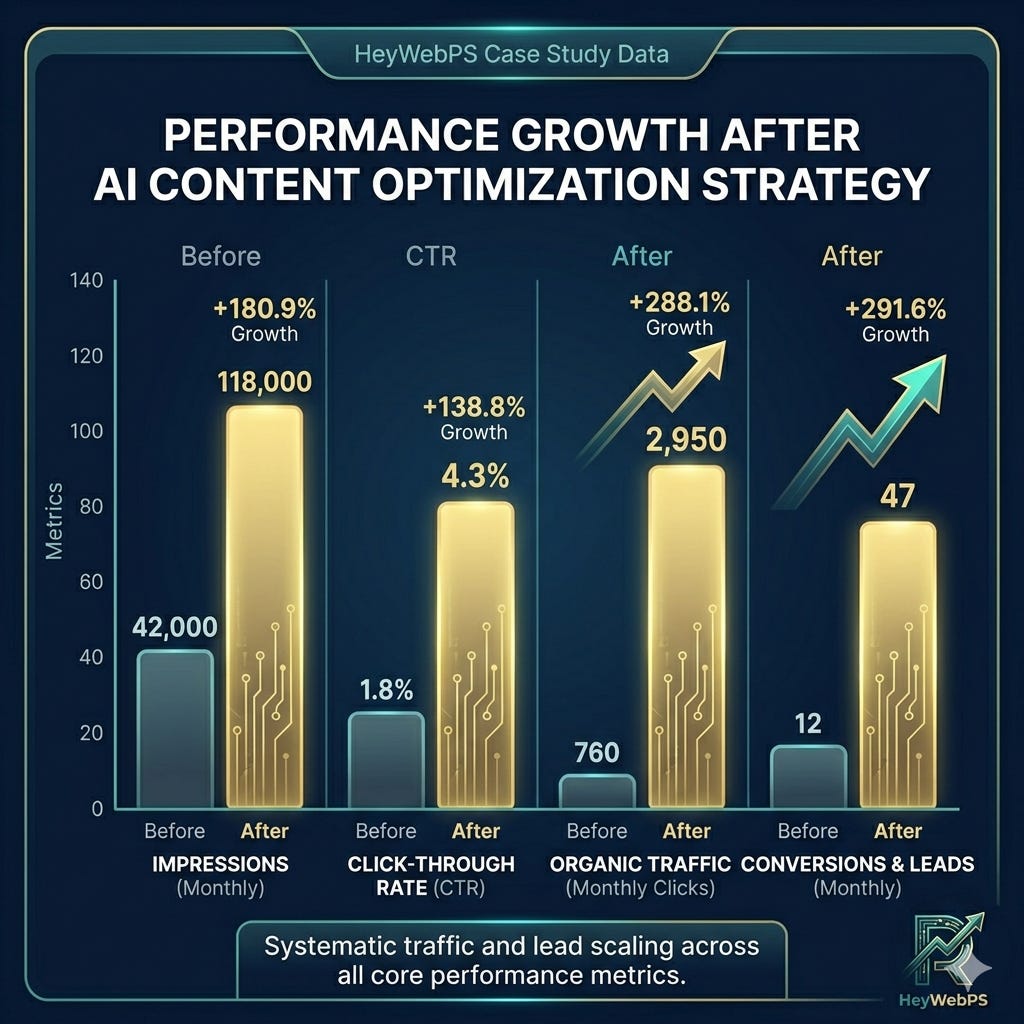
📊 Performance Metric
IMPRESSIONS (Monthly)
Before: 42,000
After: 118,000
Growth: +180.9% 🔥
CLICK-THROUGH RATE (CTR)
Before: 1.8%
After: 4.3%
Growth: +138.8% 📈
ORGANIC TRAFFIC (Monthly Clicks)
Before: 760
After: 2,950
Growth: +288.1% 🚀
CONVERSIONS & LEADS (Monthly)
Before: 12
After: 47
Growth: +291.6% 💰
The largest single driver was Step 4 (the AI Optimization Layer) combined with Step 3’s answer-first structure — both of which directly target how AI Overviews and answer engines select citation candidates.
AI Optimization Layer
AI Summary Block
An AI-driven content optimization strategy combines technical SEO, entity-first outlining, and AI-readable summaries
Content must be structured for both human skimming and AI extraction
Tables, defined terms, and answer-first paragraphs increase citation likelihood
E-E-A-T signals come from specificity, not generic claims
A 90-day case study shows traffic gains from ~760 to ~2,950 monthly sessions using this framework
Perplexity Answer Block
An AI-driven content optimization strategy is a content development process that structures articles for extraction and citation by AI systems, using entity-first outlines, answer-first paragraphs, comparison tables, and concise summary blocks, alongside traditional technical SEO practices like keyword relevance and internal linking.
ChatGPT Answer Block
To build an AI-driven content optimization strategy: map search intent (including hidden and emotional intent), create an entity-first outline defining key platforms and concepts, write answer-first paragraphs with supporting tables, add a dedicated AI summary section under 100 words per platform, and back claims with specific, checkable details rather than generic statements.
Gemini Answer Block
AI-driven content optimization strategy refers to restructuring content so it performs well across Google Search, AI Overviews, and large language models simultaneously — prioritizing clear entity definitions, structured data (tables and lists), and concise, self-contained answer blocks that AI systems can summarize accurately.
AI Overview Summary
This framework helps enterprise marketing and SaaS growth teams optimize content for both traditional search rankings and AI-generated answers. Core steps include intent mapping, entity-first outlining, answer-first writing, dedicated AI summary blocks, and specificity-driven E-E-A-T signals — supported by a documented case study showing traffic growth from ~760 to ~2,950 monthly visits over 90 days.
FAQ
1. What is an AI-driven content optimization strategy?
It’s a content process that structures articles to perform well in both traditional search rankings and AI-generated answers (AI Overviews, ChatGPT, Perplexity), using entity-first outlines, answer-first writing, and dedicated AI summary sections.
2. How is GEO different from traditional SEO?
GEO (Generative Engine Optimization) focuses on how generative AI systems select and cite sources for synthesized answers, while traditional SEO focuses on ranking links in search results pages.
3. What is AEO and why does it matter?
AEO (Answer Engine Optimization) optimizes content for direct-answer formats like featured snippets, voice search, and AI Overviews — typically through concise, structured, answer-first content.
4. Do I need separate content for AI platforms vs. Google?
No. The framework above produces a single article structured to serve both audiences, with a dedicated AI Optimization Layer added at the end.
5. How long should AI summary blocks be?
Each platform-specific block (Perplexity, ChatGPT, Gemini, AI Overview) should stay under 100 words and be fully self-contained.
6. What role do entities play in AI SEO?
Entities (brands, platforms, concepts, tools) help AI systems understand relationships and context, increasing the likelihood your content is referenced as an authoritative source.
7. How important are tables for AI citation?
Very important. Tables and structured lists are significantly easier for AI systems to parse and cite accurately than dense paragraphs.
8. What is E-E-A-T and how does it apply to AI content?
E-E-A-T (Experience, Expertise, Authoritativeness, Trust) is Google’s quality framework. AI systems favor similarly specific, experience-based content over generic claims.
9. Can enterprise teams implement this without new tools?
Yes. The framework is primarily structural and process-based; it can be applied using existing CMS and editorial workflows.
10. How long until results from AI content optimization appear?
Many teams begin seeing measurable shifts in impressions and AI citation appearances within 30–90 days, depending on publishing cadence and domain authority.
11. Should every article include an AI Optimization Layer?
Cornerstone and high-intent articles benefit most; teams often prioritize this layer for their top 10–20% highest-traffic-potential pages first.
12. How does this strategy affect lead generation?
By increasing both organic visibility and AI citation frequency, more qualified prospects discover the content during research phases, increasing top-of-funnel lead volume.
13. Is keyword research still relevant in 2026?
Yes, but keywords should be used as semantic signals within an entity-first structure rather than as the primary organizing principle.
14. What’s the biggest mistake enterprise teams make with AI SEO?
Treating AI optimization as an afterthought — bolting on a summary paragraph rather than restructuring the entire article around answer-first, entity-rich patterns.
15. How often should this framework be revisited?
Quarterly, given how fast AI search behaviours and citation patterns evolve.
30-Day Execution Roadmap
Week 1 — Audit & Intent Mapping
Audit top 10–20 existing cornerstone articles for AI-extractability
Map primary, secondary, hidden, and emotional intent for each target topic
Identify entity gaps (undefined platforms, concepts, tools)
Week 2 — Entity & Structure Rebuild
Build entity tables for priority articles
Rewrite section openings using the answer-first pattern
Convert dense comparison paragraphs into tables
Week 3 — AI Optimization Layer Rollout
Draft AI Summary Blocks, Perplexity/ChatGPT/Gemini answer blocks, and AI Overview summaries for priority articles
Add or refresh FAQ sections optimized for featured snippets
Week 4 — Distribution & Measurement
Re-promote updated articles via newsletter and social channels
Set up tracking for AI Overview appearances and citation mentions
Document baseline metrics for a 90-day before/after comparison